 Changelly
: Buying, selling, and swapping crypto
Changelly lets you swap cryptocurrencies and access provider-operated services for buying or selling crypto. A swap converts existing crypto into another asset, while purchases and sales connect crypto with conventional money. Your choice depends on the available payment route, receiving network, and exchange-rate conditions.
On this page
From available crypto to a compatible receiving address
Start with the asset you can send and the exact asset and network your receiving wallet accepts. The standard exchange takes an incoming crypto payment and delivers the converted asset to your specified address. That requires compatibility at both ends before the exchange rate becomes useful.
Suppose your priority is receiving an asset on a network that your wallet supports. Network matching remains necessary across transactions; availability, quoted output, and funding deadlines belong to the particular order. An asset appearing in a currency list does not establish that every associated network or exchange direction is available.
- Confirm that the selected input network matches the network your sending wallet will use.
- Match the output asset and network to the receiving wallet’s deposit instructions.
- Include a memo or destination tag whenever the payment instructions require one.
- Check that the amount arriving meets the order’s limits and chosen rate conditions.
- Proceed only when the quoted output, funding deadline, and receiving details suit the transfer.
Create the order for the compatible asset pair and receiving address. Check its payment instructions against the conditions above before sending the specified input. Completion means the service has sent the output and the destination has received or credited it. Keep the order details until that final receipt is clear.
If the required network is absent, stop before funding. Choose another supported receiving arrangement only after confirming its compatibility, or leave the transaction unstarted. Once you have sent funds, changing the selection is no longer a safe fallback; contact support about the existing order.
Network support comes before rate selection
A matching address format does not prove that the receiving service supports the selected asset and network. Some networks use similar-looking addresses, so an address field can accept a value without detecting the mismatch. The receiving wallet’s deposit instructions establish which network it can credit.
Availability also changes independently of address compatibility. A trading partner may suspend deposits or withdrawals, experience technical problems, or lack liquidity for a pair. An unavailable route therefore needs a fresh availability check before funding. Selecting a different network changes the transfer itself, even when the asset name looks unchanged.
When does a fixed quote hold?
A fixed quote preserves the quoted output amount when Changelly receives the exact specified input amount and the incoming transfer appears on the blockchain within the order’s funding window. The funding deadline governs that incoming payment; it does not promise that the entire exchange will finish before the countdown ends.
Floating-rate exchanges use the market rate available during processing. Their final output can rise or fall relative to the initial estimate. The choice concerns how the conversion handles market movement, while network confirmation and transaction processing remain separate dependencies.
A fixed rate therefore suits a transfer whose amount and dispatch timing you can control. Withdrawal deductions or delays at the sending service can interfere with those conditions. Check the amount that will arrive, rather than assuming the amount requested for withdrawal reaches the order unchanged.
Verification can interrupt a funded exchange
Changelly can place a transaction on hold for identity checks under its anti-money-laundering procedures. Know Your Customer, or KYC, verification can require identification and evidence explaining the origin of funds. This possibility affects access to money during processing, even when the network transfer succeeds.
A compliance investigation can take weeks or months in cases that require an extended review. An ordinary exchange estimate does not describe that investigation’s duration. Buying and selling providers also apply their own verification requirements, so eligibility for one transaction path does not establish eligibility for another.
Buying with a supported payment method
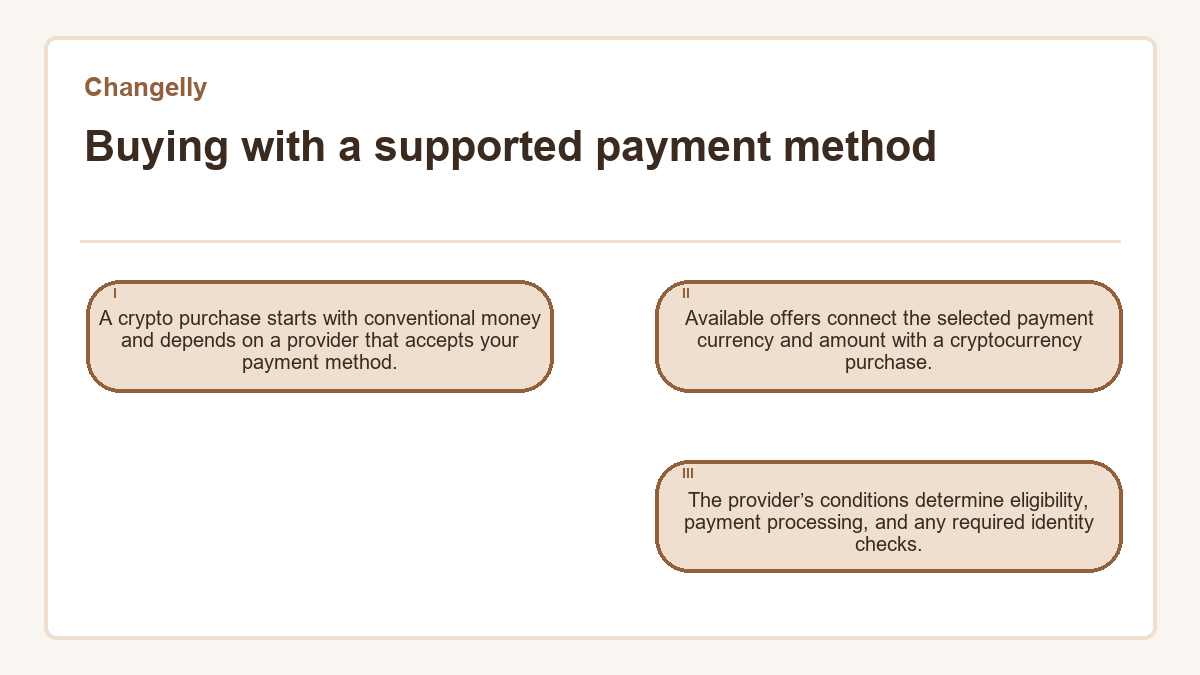
A crypto purchase starts with conventional money and depends on a provider that accepts your payment method. Available offers connect the selected payment currency and amount with a cryptocurrency purchase. The provider’s conditions determine eligibility, payment processing, and any required identity checks.
Prepare the receiving address before payment, including a memo or tag when the destination requires it. Compare the offered crypto amount alongside the payment method and provider’s restrictions. A payment option appearing elsewhere in the service does not establish that it supports this particular purchase.
Some purchases redirect to the provider; Direct Buy keeps the purchase interface within Changelly while a partner processes it. The bank, payment method, provider, and any additional verification affect delivery time. Keep the provider’s transaction confirmation because it identifies the party handling the purchase.
Selling into a supported payout method
Selling converts crypto into conventional money through a provider that supports the intended payout. The relevant conditions include the asset accepted for deposit, payout currency, country eligibility, verification requirements, and payment destination. These differ from the conditions for a crypto-to-crypto swap.
Read the sale’s rate-locking rule before sending funds. A rate displayed before deposit may remain provisional until the provider’s specified confirmation event. Check the refund-address requirements as well. The endpoint is receipt through the chosen payout method; a successful crypto deposit alone does not establish that the money has reached that destination.
Costs and limits in the selected quote
Exchange costs include service and network charges, while purchase providers determine their own fees. A fixed-rate quote uses a dynamic charge. Exchange minimums must accommodate network costs and the minimum trade that the market supports. Compare the amount payable with the expected amount receivable, and check any separate charge from the sending wallet or payment service. These details belong to the selected transaction, so an earlier quote cannot establish today’s acceptable amount.
What confirms that a swap has finished?
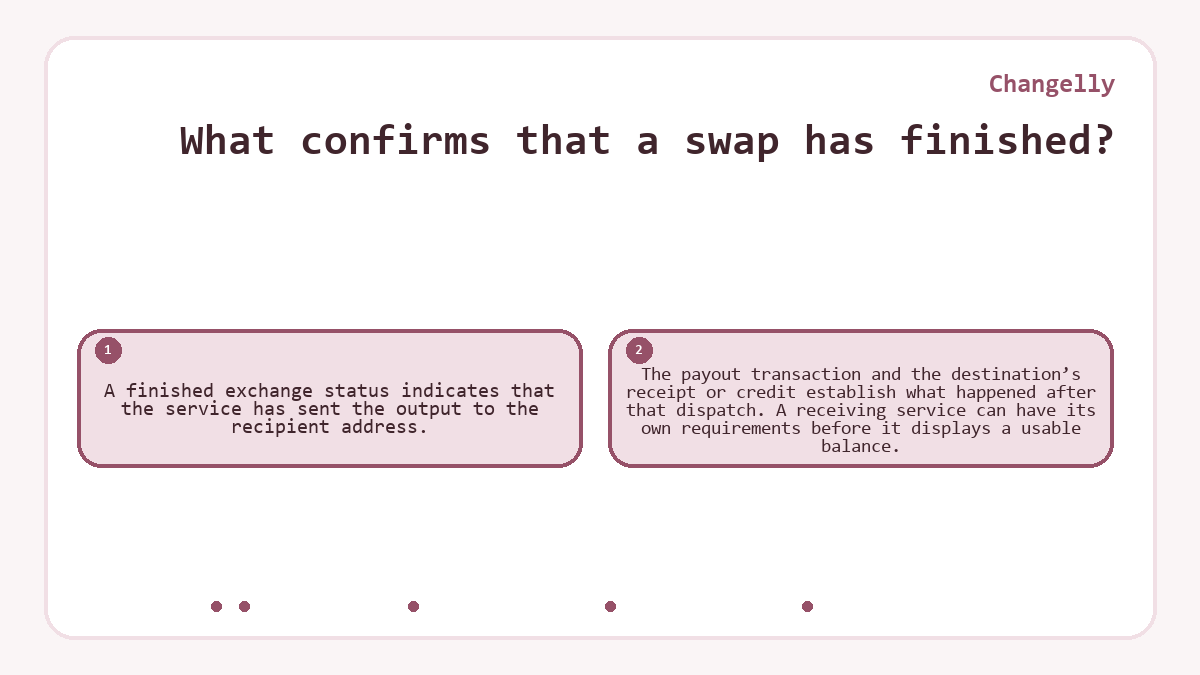
A finished exchange status indicates that the service has sent the output to the recipient address. The payout transaction and the destination’s receipt or credit establish what happened after that dispatch. A receiving service can have its own requirements before it displays a usable balance.
The earlier states identify different dependencies. Confirming means the incoming payment still needs blockchain confirmations; exchanging means conversion is underway. A hold indicates a verification interruption. These states call for different responses, so preserve the order identifier and transaction details when asking support about a delay.
A pending payment is not an instruction to send the same amount again.
Standard exchange and wallet-connected swaps
The standard exchange intermediates between an incoming payment and an outgoing asset, including supported conversions across different blockchains. This arrangement fits a task that ends with delivery to a specified address. It also introduces processing and compliance dependencies between those transfers.
Changelly DeFi Swap uses decentralized exchange aggregation and smart contracts for swaps within a blockchain. Its requirements differ: the wallet needs the network’s native currency for transaction costs, and some token swaps require a spending approval. That approval authorizes contract access to tokens.
Slippage tolerance limits the price movement acceptable to the swap. It does not provide the standard exchange’s fixed-rate commitment.
The practical comparison starts with the destination you need. A supported standard exchange can convert between assets on different networks. A wallet-connected swap instead depends on a compatible on-chain route, available liquidity, and transaction authorization. Neither mechanism substitutes for a fiat purchase or sale when the intended endpoint involves a bank or card payment.
What readers ask about Changelly
Can I reuse a deposit address from an earlier exchange?
Create a new exchange instead of sending funds to an earlier order’s deposit address. Changelly’s pay-in addresses are non-reusable and have funding windows. A payment to an old or expired address may need manual processing or a refund, subject to the amount covering the network charge.
What happens if I forget a required memo or destination tag?
A missing memo or destination tag can prevent the service from matching or crediting your payment automatically. Contact the service responsible for that deposit with the transaction details. Recovery depends on the destination and the error; an address by itself does not replace the additional identifier that its payment instructions require.
Is the Changelly order ID the same as a blockchain transaction hash?
The order ID identifies the exchange inside Changelly, while a transaction hash identifies an individual blockchain transfer. An exchange can involve separate incoming and outgoing transfers, so the hash from your sending wallet identifies a different event from the payout. Keep both the order identifier and relevant transfer hashes.
How can I cancel an exchange after sending the crypto?
Contact support immediately if you need to stop a funded exchange, although cancellation may no longer be possible. Support may be able to intervene before payout, depending on processing progress. Once the resulting transfer has gone out, the exchange cannot simply reverse it or retrieve funds from an incorrect recipient.
Does Changelly offer a mobile app?
Changelly offers apps for iOS and Android with exchange, purchase, and sale functions, plus transaction history and support access. Using an app does not remove the selected transaction’s network requirements or provider conditions, and availability of a payment route still depends on the operation you choose.
Will completing verification prevent all future checks?
Completing verification does not rule out a later request for additional information. Changelly can request further checks on subsequent transactions, and a separate purchase or sale provider applies its own requirements. Prior approval therefore does not establish that every future order will proceed without a verification interruption.
Last updated