 Changelly
 fees combine exchange charges with network costs
Changelly fees depend on the transaction type, while the total cost also includes charges for moving funds. Crypto swaps have an exchange charge and a payout network charge. Buying or selling through a payment provider uses that provider’s pricing. Compare the quoted amount you will receive, then account for any separate cost of funding the transaction.
What's inside
A useful comparison keeps the input amount, receiving asset, and network consistent. Fixed and floating quotes also carry different conditions, so a larger estimated payout does not necessarily give you the same protection against a changing exchange rate.
Compare quotes within the same transaction type
For the same input and destination, compare the net receiving amounts and the conditions attached to each quote. A floating quote can change during processing. A fixed quote offers rate protection subject to the order’s funding requirements. Its pricing can differ from the floating option.
Changelly uses a dynamic exchange charge for fixed quotes. That makes the displayed payout more useful than applying the floating service percentage to every transaction. Keep a fee breakdown alongside the payout, and avoid subtracting charges that the displayed receiving amount already includes.
| Transaction option | Condition governing the quoted outcome |
|---|---|
| Floating crypto exchange | The final output can change with the market rate during processing. |
| Fixed crypto exchange | Rate protection depends on meeting the order’s amount and funding conditions. |
| Crypto purchase | The selected payment provider determines the purchase charges and checkout terms. |
| Crypto sale | The selected provider’s quote determines the applicable charges and estimated money payout. |
Purchases and sales need their own comparisons. Compare purchase offers using the same payment currency and crypto destination. Compare sale offers using the same crypto input and payout currency. Mixing these operations into one percentage comparison hides differences in what you pay and receive.
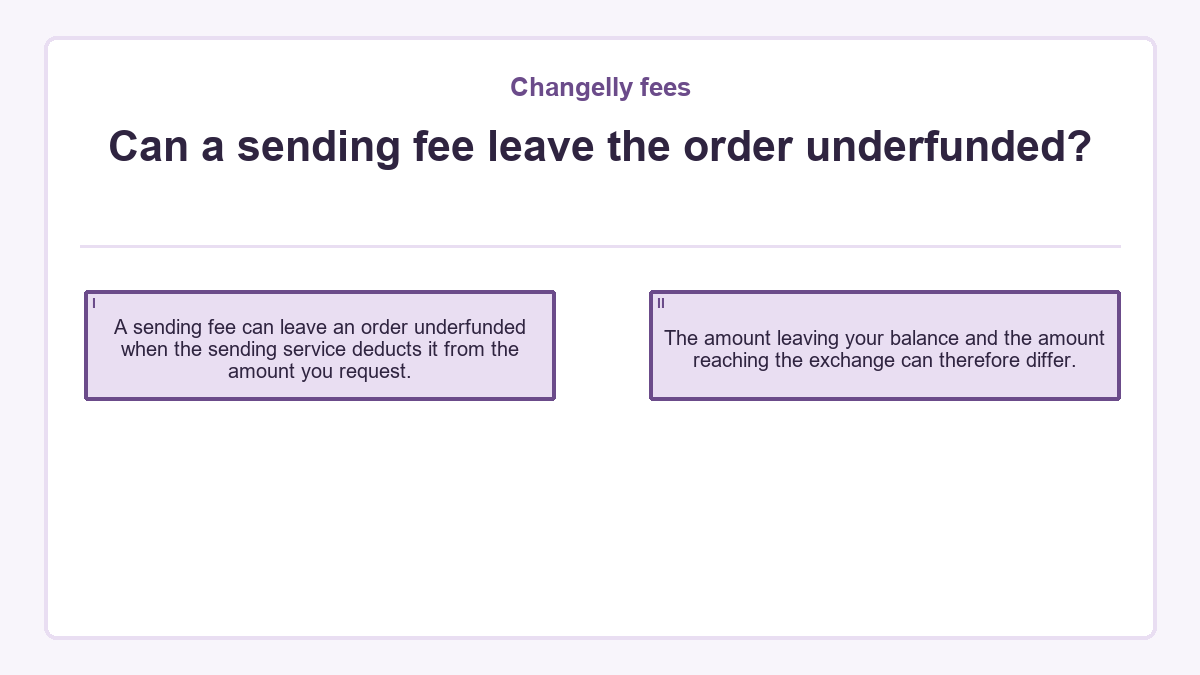
Can a sending fee leave the order underfunded?
A sending fee can leave an order underfunded when the sending service deducts it from the amount you request. The amount leaving your balance and the amount reaching the exchange can therefore differ.
The transfer preview matters here. Some sending services display a withdrawal charge separately; others subtract it from the requested withdrawal. Read the recipient amount before confirming payment, especially when the exchange expects an exact deposit.
Fixed-rate execution depends on the specified amount and the permitted funding window. Withdrawal deductions can cause a short deposit, while a delayed sending service can undermine the timing requirement. The fixed quote does not remove either constraint.
Keep the funding charge outside the quoted payout calculation unless the quote explicitly includes it. Otherwise, an apparently cheaper exchange can require more funds to deliver the deposit that its offer assumes.
Exchange charges and network charges have different recipients
Changelly receives the exchange charge for arranging the conversion, while the payout network charge covers the withdrawal through its executing exchange.
Changelly collects payout network charges and transfers them to the exchanges that execute the withdrawals. Those exchanges set their withdrawal charges, and the final network fee can differ from the estimate shown when the order is created. Consequently, the network line in an order need not equal the blockchain processing fee visible for a single transaction.
The sending side creates another cost. A wallet transaction incurs a blockchain processing charge, while a custodial sending service can impose its own withdrawal charge. Count the amount that the sending service actually charges; do not automatically add an estimated blockchain fee on top of it.
Partner integrations can introduce a further commission. Changelly’s exchange API supports an extra fee for the integrating service, so an embedded offer can differ from a direct quote. An application’s use of Changelly does not establish identical pricing.
Payment providers determine purchase and sale charges
When conventional money enters or leaves the transaction, the selected payment provider determines the applicable charges and payment conditions. A crypto exchange service percentage does not describe that entire transaction.
For purchases, compare the payment total with the crypto amount that the provider expects to deliver. The payment method, selected currencies, and country can affect the offer. Review the provider’s final transaction details before payment, since the initial selection screen does not replace checkout.
For sales, compare the crypto amount required with the estimated money payout and its stated charges. The pair, country, market rate, and volatility can affect the fee. Keep any separate cost of sending the crypto in the calculation. Provider eligibility and verification requirements also matter: an unavailable offer cannot serve as a usable cost comparison.
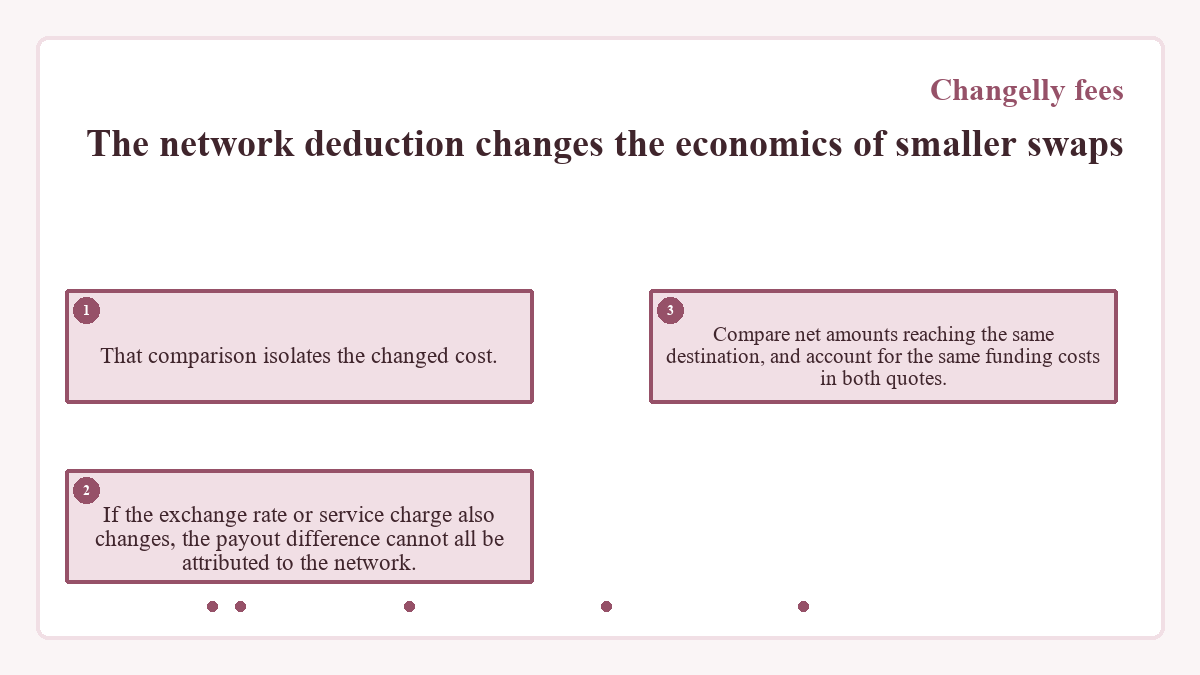
The network deduction changes the economics of smaller swaps
A network deduction consumes a larger share of a smaller exchange when the deduction stays unchanged as the amount falls. Increasing the amount can reduce that proportion without reducing the absolute charge. It also increases the funds committed to the exchange.
The minimum exchange amount reflects network costs and the minimum amount that the market can exchange. Passing that threshold means the order meets the stated minimum; it does not establish that the cost is attractive.
For a hypothetical cost comparison, suppose a quote starts with 147.5 units of the receiving asset before deductions. Assume an exchange charge of 0.59 units and a payout network charge of 0.85 units. These invented figures illustrate the arithmetic and do not represent Changelly’s fee schedule.
The net payout is 147.5 - 0.59 - 0.85 = 146.06 units. To assess a changed network charge, compare another quote for the same input, asset, and compatible receiving network. If only the network deduction rises to 1.15 units, the payout becomes 145.76 units. The additional deduction reduces the output by 0.30 units.
That comparison isolates the changed cost. If the exchange rate or service charge also changes, the payout difference cannot all be attributed to the network. Compare net amounts reaching the same destination, and account for the same funding costs in both quotes.
A displayed net payout already incorporates its included deductions. The subtraction above applies to an explicitly stated amount before fees, not to a receiving amount that already reflects them.
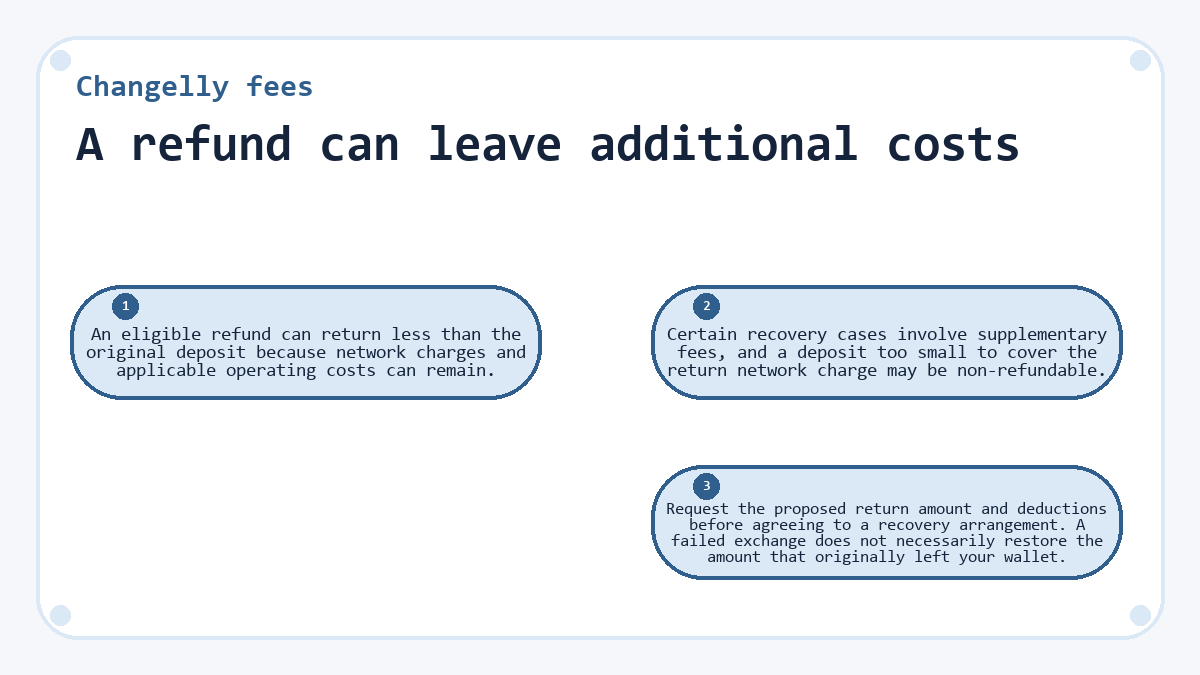
A refund can leave additional costs
An eligible refund can return less than the original deposit because network charges and applicable operating costs can remain. Certain recovery cases involve supplementary fees, and a deposit too small to cover the return network charge may be non-refundable. Request the proposed return amount and deductions before agreeing to a recovery arrangement. A failed exchange does not necessarily restore the amount that originally left your wallet.
Practical questions about Changelly fees
How can I compare fees quoted in different cryptocurrencies?
Convert the charges into the same accounting currency using a consistent valuation time before adding them. Preserve the original crypto amounts as well, because their converted values move with prices. A sending charge in one asset and a payout deduction in another cannot be added directly as token quantities. This calculation measures your combined cost; it does not change either charge.
Is every difference from a market price a Changelly fee?
A difference from a market price does not identify a separate fee by itself. The reference price can come from a different venue or time, while the exchange quote reflects its own executable terms. Separate the disclosed deductions from the rate difference before describing the cost. Otherwise, the same difference can enter your calculation twice.
Can paying in another bank currency add to a crypto purchase’s cost?
A bank currency conversion can add to the cost when your payment currency differs from the currency that the provider charges. The bank’s conversion rate affects the amount debited from your account. Compare that actual debit with the provider’s purchase total instead of assuming they are identical. A supported purchase currency matching your account currency avoids that particular conversion step.
Does splitting a Changelly swap into smaller orders reduce network costs?
Splitting a swap can increase combined network costs because each order can incur its own payout deduction and funding charge. Each smaller order must also satisfy its applicable minimum. Compare the combined net output and total funding cost of all the proposed orders with the single-order quote. A smaller charge on each individual order does not establish a lower combined cost.
What records help explain an unexpected fee deduction?
The order’s fee breakdown, sending-service withdrawal record, and actual receiving amount provide the relevant comparison. Keep the order identifier and any payout transaction record with them. Separate an external sending charge from deductions within the exchange, and distinguish an estimated floating payout from the completed amount. Share transaction details needed to investigate the discrepancy without exposing wallet recovery phrases or private keys.
Last updated